Characteristic Function Surrogates with SONY
Characteristic-function-based surrogate modelling for multi-modal neural and behavioural recordings, in collaboration with Sony Japan.
Characteristic Function Surrogates for Multi-Modal Recordings
A joint research project with SONY Japan (2025 – Present).
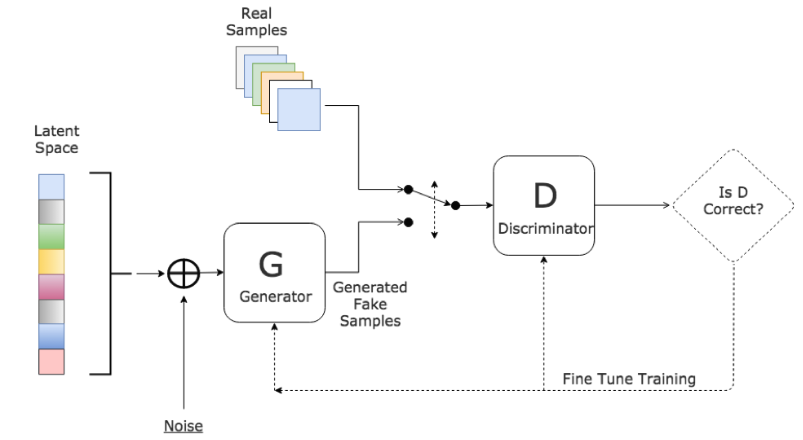
This project develops characteristic-function-based surrogate modelling for multi-modal neural and behavioural recordings. We target a setting where each example consists of seven synchronised channels (bilateral EEG, two microphone channels, and a tri-axial accelerometer), and high-quality generative surrogates are needed for both data augmentation and privacy-preserving analysis.
Approach
-
Residual Attention Convolutional Autoencoder: We design an autoencoder that operates on longer temporal windows than the initial baseline, combines residual encoder–decoder blocks with temporal self-attention, and is trained with a mixed time–frequency reconstruction loss to preserve both waveform shape and spectral content across modalities.
-
Characteristic-Function-Driven Generator: In the second stage, we learn a characteristic-function-driven generator in the autoencoder’s latent space, so that synthetic samples are produced by sampling latent codes from the generator and decoding them back into full multi-channel segments.
Together, these components provide an end-to-end pipeline from raw recordings to spectrally faithful surrogate windows, laying the groundwork for scalable augmentation of complex multi-modal datasets.